
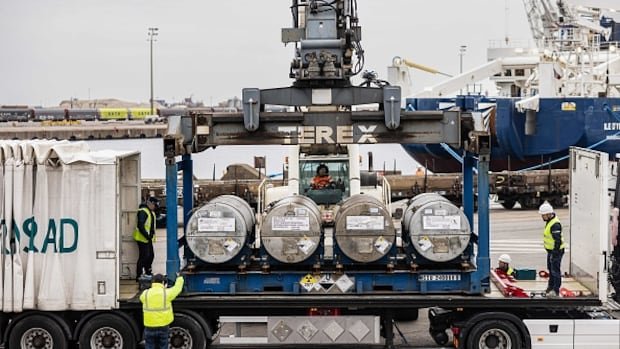

In the midst of Russian President Vladimir Putin’s military presence at Ukraine’s largest nuclear facility and attacks on the nation’s power systems, Europe and the United States continue to rely on Russian nuclear fuel to operate their electricity networks.
Westinghouse Electric, a Canadian-owned company, is one of the recipients of low enriched uranium (LEU) from Russia for fueling commercial nuclear reactors in the U.S., as per shipping data analyzed by CBC’s investigative program, “the fifth estate.”
While the U.S. implemented a ban on Russian enriched uranium imports in August 2024 to reduce dependence on Russian materials and ensure a strong domestic fuel supply, the Prohibiting Russian Uranium Imports Act allows for waivers under certain conditions until January 1, 2028.
The Bellona Environmental Transparency Center disclosed that in 2025, the U.S. imported 400 tonnes of low enriched uranium from Russia, valued at about $1 billion US. Major recipients included subsidiaries of Framatome, Global Nuclear Fuel Americas, and Westinghouse.
Despite the conflict, the European Union has not imposed a ban on Russian enriched uranium imports, and Canada has not sanctioned dealings with Russia’s Rosatom or Tenex.
Efforts to decrease reliance on Russian nuclear supplies and terminate collaborations with the country have been advocated by experts like Dmitry Gorchakov from Bellona.
Recent data analysis between Westinghouse and Tenex revealed ongoing uranium shipments to the U.S., where the material is processed into fuel pellets for nuclear reactors.
The U.S. and Europe’s prolonged dependence on Russian enriched uranium, constituting a significant portion of global supply, underscores the challenges of shifting to alternative sources while maintaining operational continuity.
Westinghouse’s notable presence in the U.S. nuclear industry and its strategic partnerships, including potential collaborations with Saudi Arabia, reflect the complex dynamics of the global nuclear marketplace.
As countries like Canada explore new reactor technologies that may require enriched uranium, efforts are underway to bolster domestic production and secure supply chains to reduce vulnerability to geopolitical disruptions.