
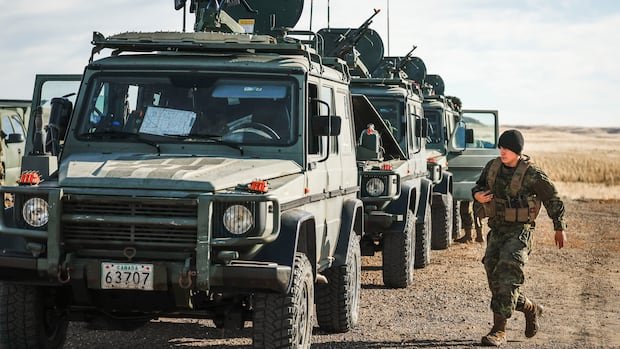

The Carney administration has quietly axed the second phase of an ongoing competition to supply light utility vehicles to the army, opting to directly invite a limited number of Canadian suppliers to bid instead, as revealed by CBC News sources. Public Services and Procurement Canada (PSPC) recently issued a notice signaling a shift towards a revised procurement approach.
The notice obtained by CBC News discloses the cancellation of the invitation for interested companies to qualify for the Light Utility Vehicle (LUV) program procurement, which could amount to $4.9 billion according to the Department of National Defence website. Initially, six primary competitors were in the running, with two being U.S. companies – AM General and Oshkosh Defence, and the remaining four Canadian firms – Armatec Survivability Group, GM Defense Canada, Roshel, and Terradyne Armoured Vehicles.
Furthermore, there are indications that the government plans to narrow down the pool of potential suppliers even further. Following the conclusion of the NATO summit, a statement from the Prime Minister’s Office highlighted new defense investments, including a reference to the updated procurement strategy for the LUV program.
The statement outlines the intention to restrict the tender to only two Canadian defense industry suppliers to deliver a specific number of vehicles and light utility trailers for the militarized section of the Canadian Armed Forces’ fleet. The specific Canadian companies to be selected remain undisclosed at this time.
This decision to favor domestic LUV suppliers was made public in a statement from the Prime Minister’s Office at the conclusion of the NATO summit in Turkey, coinciding with the multibillion-dollar announcement to purchase submarines for the navy from German shipbuilder ThyssenKrupp Marine Systems (TKMS).
The PSPC notice emphasized that refocusing the LUV program is aimed at enhancing Canada’s defense industrial base. Defense Minister David McGuinty refrained from commenting on the program’s status during the NATO summit, indicating that further details would be provided later.
Moreover, the LUV program has been split into distinct phases, with the first phase involving the replacement of the army’s aging fleet of Mercedes G-Wagons and Chevrolet Silverados. Additionally, Canada is set to enter into an $800 million contract with the Norwegian company Kongsberg Defence and Aerospace for the procurement of joint strike missiles (JSM), designed for advanced anti-ship and land-attack capabilities.
The statement also highlighted an agreement in principle concerning the Defense Department’s Enhanced Satellite Communications Project – Polar (ESCP-P) to leverage the Telesat Lightspeed system for reliable military satellite communications in the Arctic. The ESCP-P program’s estimated value stands at up to $5 billion as per the department’s website.